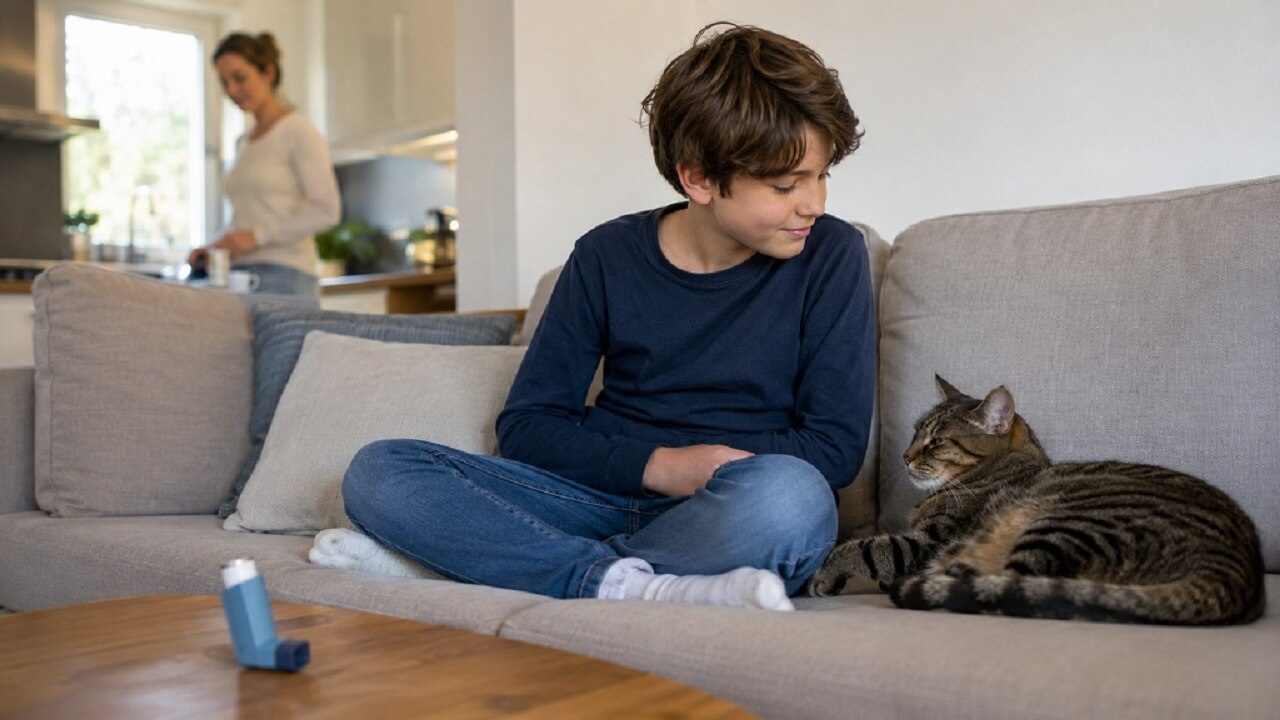
Parents of children with asthma often worry that a cat at home could worsen coughing, wheezing, or flare-ups.
New research answered this question, and you will love it if you or your kid wanted a cat in your home.
A large Swedish registry study found no evidence that living with cats worsened short-term asthma outcomes in children who already had asthma and allergies.
“Parents don’t have to give away Kitty or Tabby to protect their kids,” according to the plain-language summary of the findings. Still, care should stay personal.
Results do not prove that cats are safe for every child with asthma, especially children with confirmed cat allergy or poorly controlled symptoms.
Overview of the Study

Researchers at Karolinska Institutet in Stockholm conducted the study. Findings were published online in Frontiers in Allergy on June 10, 2026.
Its title was “Cat exposure and asthma outcomes in a cohort of children with asthma and allergy,” with DOI 10.3389/falgy.2026.1840756.
Dr. Resthie R. Putri, a postdoctoral researcher at Karolinska Institutet, was the lead and corresponding researcher.
Catarina Almqvist Malmros, professor at Karolinska Institutet and pediatrician at Astrid Lindgren Children’s Hospital, also commented on the clinical meaning of the findings.
Researchers analyzed 30,277 children in Sweden. Participants were ages 4 to 17 at the start of the study, were born between 2006 and 2020, and had asthma or airway allergy.
Cohort analysis began in 2023. Children were followed for 24 months, through 2024.
Researchers used data taken via several national sources:
- Swedish National Patient Register
- Prescribed Drug Register
- National Airway Register
- National Cat Register
Cat exposure was measured by checking if a parental household had at least one registered cat in 2023.
Sweden’s National Cat Register has been mandatory since 2023 for pet cats born after 2008. In the study, 9.4% of children lived in a household with at least one cat.
Main Findings
Children living with one or more cats had similar asthma outcomes to children without cats at home.
Dr. Putri said children living with cats had similar asthma severity, exacerbation, asthma control, and lung function compared with children living without cats in the short term.
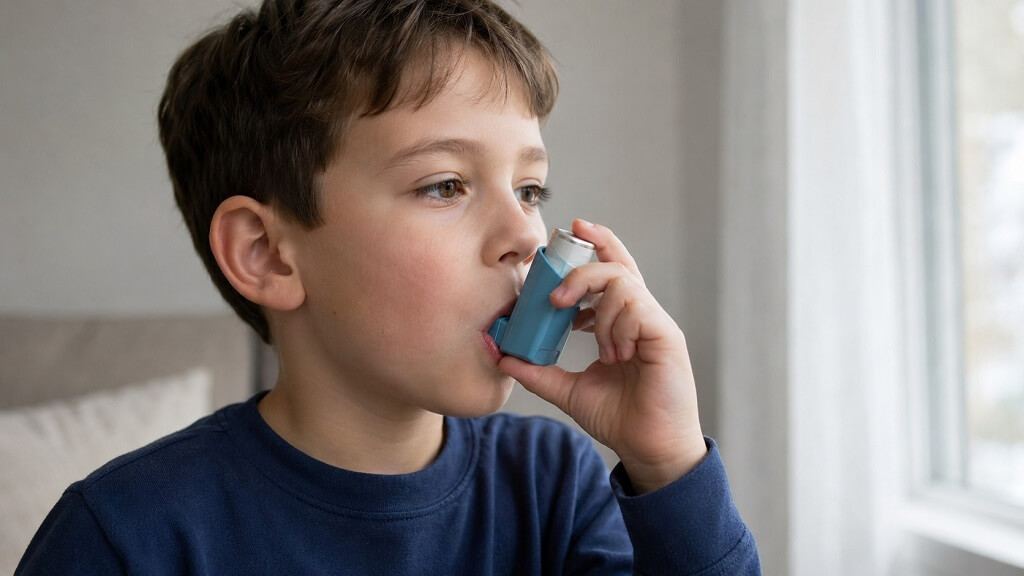
Researchers measured:
- Asthma exacerbations leading to emergency care
- Asthma severity based on medication use
- Asthma control
- Lung function measured with spirometry
Moderate-to-severe asthma occurred in 9.6% of cat-exposed children and 10.1% of children not exposed to cats at home.
Asthma exacerbations, meaning flare-ups or attacks, occurred in 3.3% of cat-exposed children and 3.5% of children without household cat exposure.
Spirometry and asthma-control data were available for 1,428 children. In that subset, 97 children, or 6.8%, lived with cats.
Researchers found no significant differences between cat-exposed and non-exposed children in two common lung-function measures.
Cat details also did not create meaningful differences. Results did not change clearly based on:
- Number of cats in the home
- Cat age
- Cat sex
In simple terms, moderate-to-severe asthma appeared in about 10% of either group, asthma attacks appeared in about 3% of either group, and overall lung function did not show significant differences.
You Can Adopt a Kitten Without Worrying, Or is it Always the Case?
Findings may reassure families that already have cats.
In this large Swedish cohort, cat ownership was not linked to worse short-term asthma outcomes in children with asthma and allergies.
Care should still be individualized. Families should consider the child’s symptom pattern, asthma control, allergy testing, and physician guidance before deciding to keep, remove, or adopt a cat.
Along with medical guidance, families may also review everyday home habits that affect comfort, especially in the child’s bedroom.
That can include washing bedding often, keeping pets off the bed when symptoms seem worse at night, and using protective bedding such as a Mattress Protector to help keep the sleep surface cleaner.
Catarina Almqvist Malmros said clinical advice always needs to be tailored to the individual. She also said the study can help support evidence-based conversations with families about pets and asthma.
Families should not conclude that cats can never trigger symptoms. Cat allergy can still matter.
A child with poorly controlled asthma should not ignore coughing, wheezing, chest tightness, or flare-ups that seem linked to a pet.
A careful takeaway is that cat ownership should not automatically be treated as harmful for every child with asthma and allergies.
Removing a cat may not be necessary for all families, especially without evidence that the child is cat-allergic or that symptoms worsen around the cat.
Possible Explanation for the Results
Researchers suggested one possible explanation: cat allergens may be common even outside homes with cats.
Children without cats at home may still encounter cat allergens in places such as:
- Schools
- Public transportation
- Shared indoor spaces
Cat allergens can travel on clothing, bags, and surfaces. Because of that, household cat ownership may not be as separate an exposure category as many parents assume.
A child without a cat at home may still meet cat allergens often enough to reduce the difference between cat-owning and non-cat-owning households.
Dr. Putri described this as one possible explanation, not a confirmed cause of the findings.
Important Limitations of the Study
Researchers did not have information on each child’s specific allergies. Because of that, they could not tell which children were actually allergic to cats.
That is a major limit. Results apply to children with asthma and allergies broadly, not only to children with confirmed cat allergy.
Sweden’s Cat Register is also new. Since registration became mandatory in 2023 for pet cats born after 2008, some cat exposure may have been missed or misclassified.
Researchers also lacked several household details:
- Length of cat exposure
- Time cats spent indoors
- Cat access to bedrooms
- Constant, occasional, or mostly outdoor exposure
- Cleaning routines
- Ventilation
- Actual allergen levels in the home
Family choices may also have shaped the results. Families with children who had more severe allergies may have already avoided keeping cats.
Findings may not apply equally outside Sweden. Differences in housing, pet registration, health care, asthma care, environment, and allergy patterns may affect results in other countries.
Follow-up lasted two years, so the study looked at short-term outcomes. Longer-term effects still need more research.
Study design also matters. Registry-based observational research can show associations, but it cannot prove that cat exposure has no effect for every child.
What Researchers Plan To Study Next

Researchers plan to keep following the children for a longer period.
A longer follow-up could show if cat exposure has delayed effects that were not visible between 2023 and 2024.
Future research will also look more closely at allergy types. More detailed allergy data could separate children with confirmed cat allergy from children with other allergic conditions.
That distinction matters. A child with asthma and hay fever may not react to cats in the same way as a child with asthma and a confirmed cat allergy.
Researchers also plan to examine how cat ownership may affect asthma over time, not only during a two-year follow-up.
FAQs
Closing Thoughts
New 2026 research found no link between living with cats and worse short-term asthma outcomes among children with asthma and allergies in Sweden.
Moderate-to-severe asthma rates were similar between cat-exposed and non-exposed children, at 9.6% versus 10.1%. Asthma flare-up rates were also similar, at 3.3% versus 3.5%.
Cats may not need to be automatically avoided in every household with an asthmatic child. Decisions should still depend on symptoms, confirmed allergies, asthma control, and medical advice.
A more accurate takeaway is not that cats are safe for all children with asthma. It is that cats were not associated with worse short-term asthma outcomes in this large Swedish cohort.