
An invasive Manila clam prized in seafood markets has established breeding populations along the Massachusetts coast, ending the Northeast’s status as the last major part of the Northern Hemisphere where the species had not taken hold.
Scientists have confirmed live Manila clams in Boston Harbor, on Cape Cod and as far north as Salem Sound. The discovery involves more than a few discarded shells. Researchers found adults, recently settled clams and tiny juveniles, proving that the species is reproducing in local waters.
The finding has raised concern because Manila clams can form dense colonies, compete with native shellfish and change life on the seafloor. Scientists are not calling the discovery an ecological disaster. They are trying to determine how far the clam has spread and what role it will play in New England waters.
Table of Contents
ToggleWhat Scientists Confirmed?
- The species is the Manila clam, scientifically known as Ruditapes philippinarum.
- Reproducing populations were found around Cape Cod and Boston Harbor.
- The northernmost confirmed observations reach Salem Sound.
- Researchers found juvenile clams as small as 500 micrometers.
- The species is native to parts of East Asia.
- Scientists do not yet know how it reached Massachusetts.
- Its environmental impact in New England remains uncertain.
- Residents are being asked to photograph and report sightings rather than move live clams.
The Discovery Began With Reports of “Weird Clams”
Local shellfish harvesters began reporting unfamiliar clams around Provincetown and other Cape Cod locations in 2023.
A second line of investigation started in Boston Harbor after a former University of Rhode Island student sent marine scientist Aly Putnam a photograph of a clam found during a biodiversity workshop on Spectacle Island.
Putnam and MIT Sea Grant researcher Carolina Bastidas began searching the island and found Manila clam shells in large numbers. The shells alone were not enough to prove that a population had become established. They could have been discarded seafood, bait or material carried from another location.
Researchers needed living clams, especially small ones that could only have come from recent local reproduction.
Teams later dug through sediment at Squantum in Quincy and Calf Pasture Park in Boston. They found dozens of young live clams. Female clams collected from Cape Cod also showed evidence of reproduction.
The peer-reviewed study published in Biological Invasions documents observations from multiple locations between 2023 and 2025. Adult clams measured between 31 and 71 millimeters, while sediment sampling uncovered settlers measuring only 500 micrometers and juveniles between one and seven millimeters.
That size range is important. It shows several stages of the clam’s life cycle living in Massachusetts rather than one group of adults surviving after an isolated release.
What Is a Manila Clam?
The Manila clam is native to coastal waters extending from Russia’s Sakhalin Islands through Japan and southern China.
It is also known as the Japanese littleneck clam or Asari clam. The species is widely farmed and eaten in Asia, Europe and along the Pacific coast of North America.
The clam has become a major commercial product, supporting a global industry valued at about $7 billion. Its value as food is one reason people have intentionally moved it into new regions for aquaculture.
Manila clams usually live buried in sand, mud or gravel in shallow coastal waters. They filter small particles and plankton from the water.
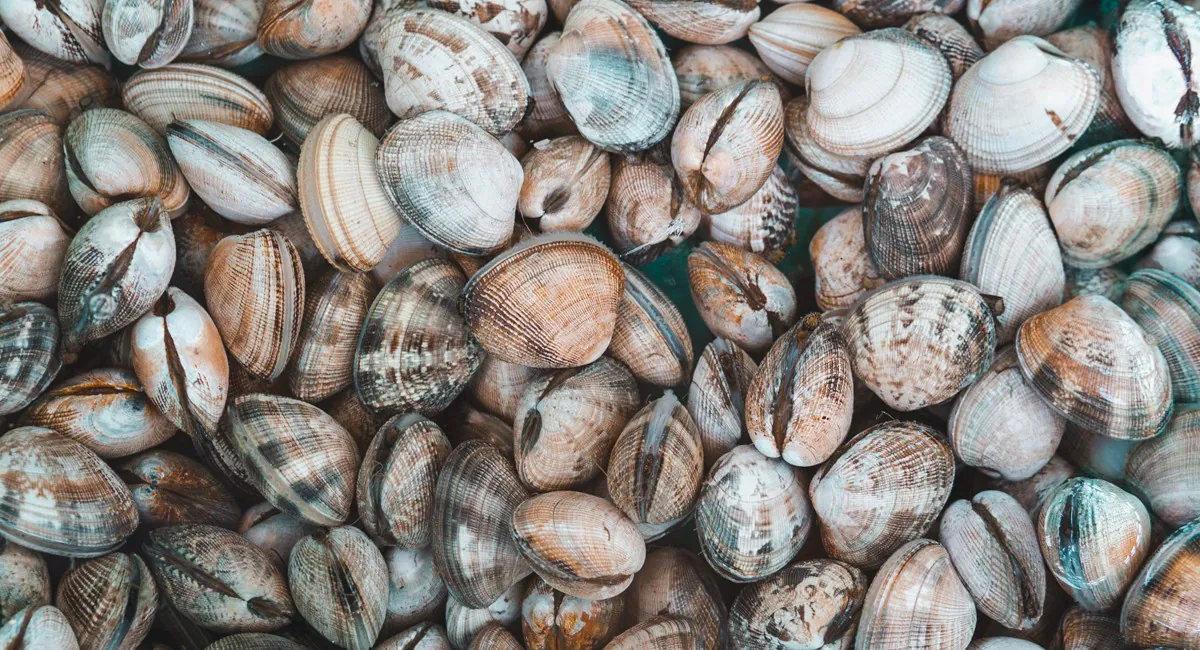
The shell commonly has a cross-hatched pattern created by ridges running in different directions. Native quahog and surf clam shells usually have more obvious growth lines running parallel to the shell edge.
How Did the Clams Reach Massachusetts?
No introduction route has been confirmed.
The species has been moved around the world through shellfish farming and the live seafood trade. Accidental transport can also occur when live shellfish, bait, contaminated aquaculture equipment or sediment are moved between coastal regions.
Ships are another possible pathway for marine invaders. Microscopic larvae and other small organisms can travel in ballast water, although there is no proof that ballast water brought the Massachusetts population.
Researchers will need genetic testing to compare the New England clams with populations from the Pacific coast, Europe and Asia. A close genetic match could help identify where the founding clams originated.
Ocean warming may also affect what happens next. Warmer coastal water could improve survival or lengthen the reproductive season for some nonnative species. Climate change alone cannot introduce a clam across an ocean. Human activity would still be needed to bring the first individuals into the region.
The study does not identify warming as the cause of the invasion. It remains one factor scientists may examine as they track whether the population moves farther north.
How Serious Is the Environmental Risk?
Scientists do not know yet.
Manila clams have caused ecological changes in some places where they became abundant. Dense populations can compete with native clams for plankton, oxygen and space within coastal sediment.
New England already supports commercially and ecologically important shellfish, including soft-shell clams, northern quahogs, surf clams, oysters and mussels. Competition could become significant if Manila clam numbers rise quickly in the same habitats.
Large colonies may also change the sediment. Clams disturb the seafloor as they burrow, feed and release waste. At high densities, that activity can affect nutrient movement and the small worms, crustaceans and other animals living in the mud.
Changes at the bottom of the food web can spread upward. Fish, birds and crabs may gain a new source of food. Native shellfish may face greater competition. Predators may change where and how they feed.
Another concern involves parasites and disease. Shellfish moved between regions can carry organisms that are difficult to detect. No evidence currently shows that the Massachusetts Manila clams introduced a new disease. Monitoring will need to include health risks as well as population growth.
New England’s coastal habitats already face warming water, pollution, development and established invaders such as European green crabs. Another successful species could add pressure to an ecosystem managing several changes at once.
More background on the state’s coast and marine environment is available in the our Massachusetts geography guide.
The Clams Could Also Help Some Native Animals
The environmental outcome may not be entirely negative.
Manila clams can become food for seabirds, fish, raccoons and crabs. Researchers said the new prey could reduce some of the pressure that invasive green crabs place on native soft-shell clams.
A new commercial fishery is also possible if the population becomes large enough and harvesting is legally approved. Manila clams are already an important seafood product elsewhere.
Commercial value does not remove the ecological risk. A profitable invasive species can still change habitats or displace native shellfish. Creating a market can also encourage people to move the species into new waters, making control more difficult.
The most likely result may fall between two extremes. Manila clams could remain a limited addition to the ecosystem, or they could become common enough to alter shellfish beds and local fisheries. Several years of monitoring may be needed before that becomes clear.
Why Stopping the Spread Will Be Difficult?
Finding tiny juveniles at several locations means the species has moved beyond the stage when removing a few adults could solve the problem.
Marine clams release eggs and sperm into the water. Their larvae can remain suspended before settling into suitable sediment. Currents can carry them away from the original colony.
Eradication becomes extremely difficult after a marine species begins reproducing across several open coastal sites. Managers are therefore more likely to focus on mapping the population, slowing human-assisted movement and measuring its ecological impact.
Massachusetts already operates the Marine Invader Monitoring and Information Collaborative. The program brings scientists, resource managers and volunteers together to search for nonnative marine species from Rhode Island to Maine.
The Manila clam discovery shows the value of that network. Local harvesters, students, volunteer observers and professional scientists each contributed evidence that helped confirm the invasion.
People who find a possible Manila clam should photograph it and record the location. Useful reports include the date, approximate size, number of shells and whether the clam was alive or dead.
Observations can be uploaded to iNaturalist. Researchers are especially interested in live clams smaller than about three centimeters because juveniles help identify active breeding areas.
Live clams should not be moved to another beach, harbor or tidal flat. Relocation could carry the species beyond its current range.
People should also avoid eating unidentified clams collected from unapproved areas. A clam being edible as a species does not make every individual safe. Coastal waters can be closed because of bacteria, sewage, harmful algae or other contamination.
Massachusetts publishes shellfish closure and reopening notices. Local harvesting permits and size limits may also apply.
The discovery has received wider attention through reports from FOX Weather and MassLive, but the confirmed range remains centered on Massachusetts. Evidence does not yet show breeding colonies along the entire Atlantic coast.
Final Thoughts
The Manila clam is no longer an occasional visitor to Massachusetts. It is living, reproducing and appearing at several points along the coast.
The species could compete with native shellfish and alter seafloor communities if its numbers rise. It could also feed birds and crabs and eventually support a fishery.
The next few years will show which outcome becomes more important. Careful monitoring now gives scientists a rare chance to watch a marine invasion near its beginning rather than trying to reconstruct it decades later.
Related Posts:
- FDA Panel Backs Six Popular Peptides for Pharmacy…
- Screwworm Detected 25 Miles From U.S. Border As…
- Asia on Alert as Nipah Virus Outbreak in India…
- The US Just Banned Roombas, and the Rule Hits Far…
- GLP-1 Drugs Could Help Treat Addiction, Researchers…
- A Hidden World Lives in Your Belly Button, And It Is…