


The United States has 989 billionaires in 2026, more than any other country, according to the latest Forbes World Billionaires list. The same Forbes ranking puts their combined wealth at $8.4 trillion.
The biggest change in the wealth ranking came in June, when Elon Musk became the world’s first trillionaire after SpaceX began trading publicly. Forbes said Musk crossed the $1 trillion mark after SpaceX stock opened on Nasdaq and lifted the value of his stake in the company.
The United States no longer leads the world in the billionaire count. It is also home to the first person publicly estimated to be worth above $1 trillion in personal net worth. The global billionaire population stands at 3,428 people with a combined net worth of $20.1 trillion, based on the annual Forbes ranking.
That means American billionaires make up about 29% of the world’s billionaire count, while holding about 42% of billionaire wealth worldwide.
Measure
2026 figure
What it shows
U.S. billionaires
989
The United States has the largest billionaire population in the world
Combined U.S. billionaire wealth
$8.4 trillion
American billionaires hold the largest national share of billionaire wealth
Global billionaires
3,428
The global billionaire class reached its highest headcount in the Forbes annual ranking
Global billionaire wealth
$20.1 trillion
Billionaire wealth worldwide crossed the $20 trillion line
U.S. share of global billionaire wealth
About 42%
The largest American fortunes are unusually large even by billionaire standards
Elon Musk Became The Worlds First Trillionaire In 2026
Elon Musk became the first person publicly estimated at more than $1 trillion in net worth after the SpaceX IPO in June 2026. Forbes declared Musk the worlds first trillionaire after SpaceX shares began trading and gave the company a market value of nearly $2 trillion.
The SpaceX listing changed the way Musk’s wealth is measured. Before the IPO, a large share of his fortune depended on private-company estimates. After the listing, public trading gave investors a market price for SpaceX shares, which made the value of his stake easier to calculate.
Forbes estimated Musk’s net worth at about $1.1 trillion after the first day of SpaceX trading. The figure remains on paper because most of that wealth is tied to company shares, not cash in a bank account.
Musk’s wealth rose so sharply because SpaceX became a public company at a massive valuation. When a founder owns a large stake in a company that reaches a market value above $2 trillion, personal net worth can move by hundreds of billions of dollars in one trading session.
SpaceX is now the main driver of Musk’s fortune. Tesla remains part of his wealth, but the June 2026 shift made SpaceX the larger force in the calculation.
That also means Musk’s net worth can move sharply down as well as up. After the IPO surge, SpaceX shares later fell from their peak, and Business Insider reported a 27% drop from the post-IPO high.
A move of that size can cut hundreds of billions of dollars from a paper fortune without changing the underlying companies overnight.
The Richest Americans In 2026
The richest Americans in 2026 are concentrated in technology, space, artificial intelligence, retail, finance, and large public companies.
The top of the list is led by Elon Musk, followed by technology founders and major shareholders from Alphabet, Amazon, Meta, Oracle, Nvidia, Berkshire Hathaway, Walmart, Dell Technologies, and Microsoft.
The Forbes 2026 Top 200 ranking shows how much the highest end of the list depends on technology ownership.
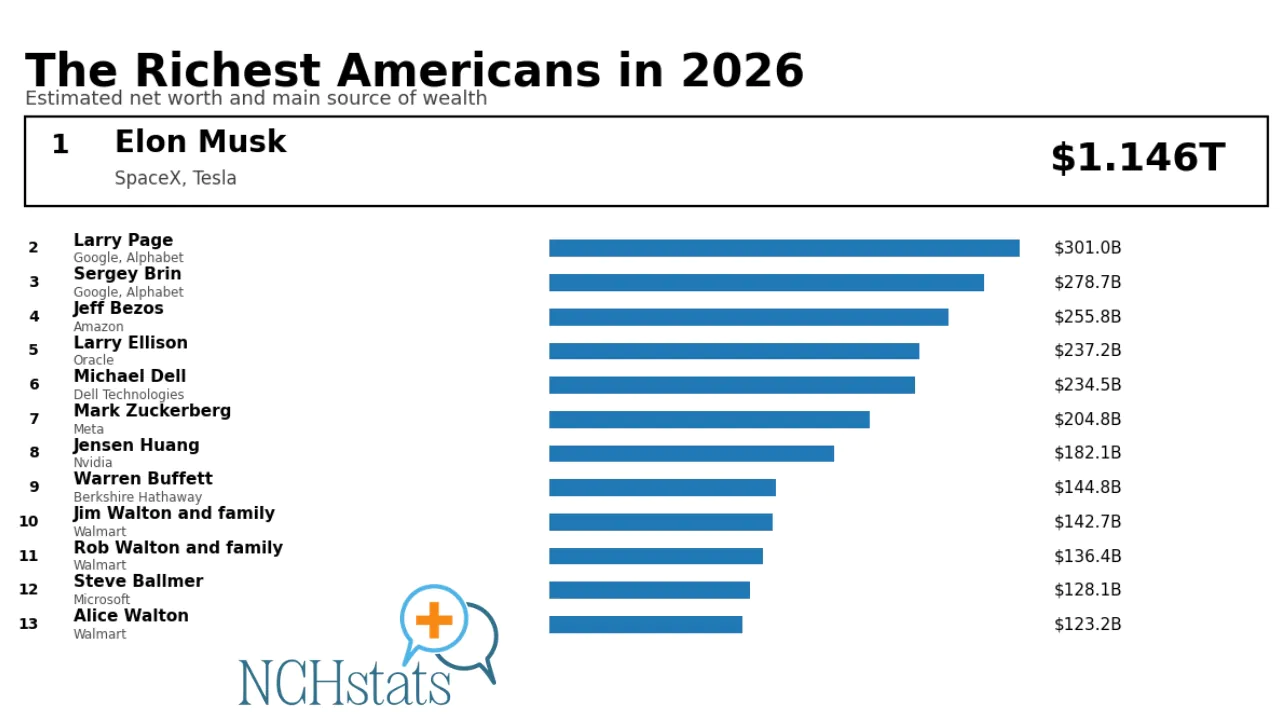
Rankings move during the year because much of this wealth is tied to public shares. A single trading day can move a billionaire up or down by billions of dollars.
Technology And AI Dominate the List
Technology creates very large fortunes because founders and early investors can hold major ownership stakes in companies that scale worldwide. A successful software, chip, cloud, or platform company can reach hundreds of billions or trillions of dollars in market value.
AI added another layer to that pattern in 2026. NVIDIA, Oracle, Microsoft, Alphabet, Meta, Dell Technologies, and other companies tied to chips, data centers, cloud contracts, and AI infrastructure helped push major fortunes higher.
SpaceX also turned the wealth map in a new direction. The company is tied to rockets, satellites, Starlink, national security contracts, space infrastructure, and public-market excitement around future growth. That mix gave Musk a path to a trillion-dollar fortune.
Technology wealth is different from salary income. A founder does not need a billion-dollar paycheck to become a billionaire. Ownership does the work. If the company value rises, the stake rises with it.
How does the United States Compares With Other Countries?
The United States leads the world with 989 billionaires. China ranks second, and India ranks third, according to the Forbes country breakdown for 2026.
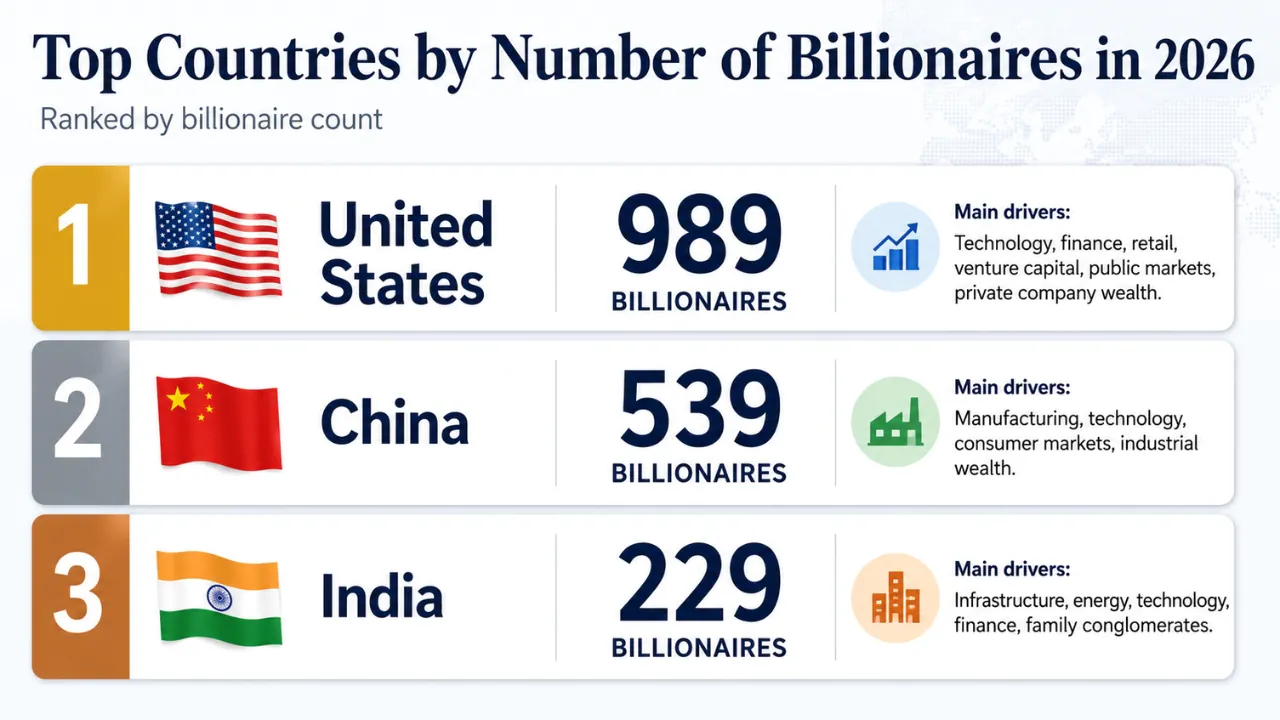
The U.S. advantage is not only about population. It comes from company formation, stock markets, venture funding, deep capital pools, private equity, equity compensation and the ability to turn private company ownership into public wealth.
Where Billionaires Live In The United States?
Billionaire wealth is concentrated in a small number of states. California, New York, Florida, and Texas remain the main billionaire hubs because they combine large economies, major metro areas, finance, technology, energy, real estate, and private wealth networks.
We have covered the wider economic map in our guide to U.S. states ranked by GDP. The billionaire map follows many of the same patterns because the largest state economies also contain the strongest business networks, investment markets, and company headquarters.
State
Why billionaires cluster there
2026 context
California
Technology, venture capital, entertainment, real estate, and private company wealth
Silicon Valley and Los Angeles remain major sources of billion-dollar fortunes
New York
Finance, hedge funds, private equity, real estate, and media
New York City remains one of the main centers of wealth management and finance
Florida
Wealth migration, finance, real estate, and no state income tax
Miami and Palm Beach have gained from the billionaire relocation
Texas
Energy, SpaceX, Tesla, technology relocation, finance, and no state income tax
Texas gained more attention after SpaceX helped push Musk past $1 trillion
Washington
Microsoft, Amazon, and technology wealth
The Seattle region remains tied to major tech fortunes
California, Texas, Florida, and New York – Explain The Map
California remains one of the most important billionaire states because it has Silicon Valley, venture capital, software companies, AI firms, entertainment wealth, and high-value private startups.
View this post on Instagram
Texas has become more important because Musk-linked companies, energy wealth, business migration, and no state income tax have pulled more billionaire attention toward Austin, Dallas, Houston, and the Space Coast area around Starbase.
Florida has become a billionaire destination through Palm Beach, Miami, and private wealth migration. No state income tax gives wealthy households another reason to move there, especially when large stock gains or company sales are expected.
New York remains the financial capital of American wealth. Hedge funds, private equity firms, banks, media companies, real estate families, and family offices keep the state near the top of the billionaire map.
State tax policy is one reason billionaire residents keep drawing attention. We have covered the broader state tax picture in our guide to the highest and lowest income tax states.
How Billionaire Wealth Is Measured?
A billionaire is a person with an estimated net worth of at least $1 billion. Net worth is assets minus debts.
For public company founders, the calculation is direct because shares trade every day. If a person owns 300 million shares and the stock trades at $100, that stake is worth $30 billion before debt, taxes, pledges, or other adjustments.
For private company owners, valuation is harder. Researchers look at funding rounds, sales, profits, comparable companies, ownership documents, debt, and outside investor prices.
Before the SpaceX IPO, Musk’s SpaceX stake depended on private valuation estimates. After the public listing, the market gave the company a daily share price.
The Forbes 2026 facts and figures report says the annual list used values as of March 1, 2026. That annual snapshot remains useful, but June changed the top of the ranking because SpaceX later became public and Musk crossed $1 trillion.
Why Billionaire Counts Change During The Year

Billionaire counts change because asset prices change. Someone worth $1.05 billion can fall below the line after a market decline. Another founder can cross the line after a stock jump, funding round, IPO or acquisition.
Daily billionaire trackers move faster than annual rankings. Annual rankings give a fixed point for comparison. Daily trackers show market movement after that point.
That distinction is important in 2026 because the Forbes annual list counted Musk below $1 trillion in March, while the SpaceX IPO pushed him above that mark in June. Both figures belong to 2026, but they describe different dates.
For day-to-day movement, Forbes maintains a real-time billionaire ranking, where net worth estimates shift with public markets and updated private company valuations.
What Billionaire Wealth Says About The US Economy
The billionaire numbers show how much wealth now sits in company ownership. The richest Americans hold fortunes linked to shares, private companies, investment funds, intellectual property, real estate, and family businesses.
Middle-class households live in a different system. Their finances depend far more on wages, salaries, rent, mortgages, insurance, food, childcare, healthcare, and retirement savings. We have looked at that side in our report on middle-class income in the U.S.
The gap between those two worlds explains why billionaire wealth can rise while many households still feel financial pressure. A billionaire can gain from asset inflation. A regular household needs a monthly income to keep up with bills.
Billionaire Wealth And Taxes

Billionaire wealth creates a tax debate because much of it sits in assets that have not been sold. Under the U.S. tax system, unrealized gains are generally not taxed as regular income until an asset is sold.
That means a billionaire can gain billions on paper from rising stock values without paying income tax on that gain at the time it appears. Taxes usually come later through sales, dividends, compensation, estate rules, or other events, depending on how the wealth is structured.
Americans for Tax Fairness said U.S. billionaire wealth rose from $6.7 trillion to $8.2 trillion during 2025, based on Forbes data, while the number of billionaires rose from 814 to 935.
That report was published before the 2026 Forbes annual ranking and before the SpaceX IPO, but it helps show the speed of the wealth increase before Musk crossed $1 trillion.
We have covered the income-tax side in our explainer on who pays the most taxes in America. Billionaire wealth adds another layer because asset gains and wage income are taxed in different ways.
California Billionaire Tax Debate Shows The Political Pressure
California is one of the best examples of how billionaire wealth has moved into politics. The state has a 2026 billionaire tax proposal aimed at residents worth at least $1 billion.
We covered that fight in our report on the California billionaire tax proposal. The idea is politically important because California has both a large billionaire population and high public spending needs.
Supporters say billionaires can pay more to support health care, schools, and public services. Opponents say a state-level wealth tax could push billionaires to change residency, move assets, or challenge valuations.
The debate also shows why states care so much about wealthy residents. A small number of ultrawealthy households can shape tax collections, political donations, business investment, and relocation trends.
Federal Revenue And Billionaire States

States with many billionaires also tend to have large tax bases, but the relationship is complicated. Population size, wages, corporate profits, payroll taxes, capital gains, and federal spending all shape the flow of money between states and Washington.
We have covered that issue in our guide on which states contribute the most to federal revenue. California, New York, Texas, Florida, and Washington all matter in that discussion because they combine large economies with high-income households and major companies.
Billionaire residence can change state tax exposure, especially when someone has large capital gains, business sales, or major estate planning decisions. That is one reason moves between California, Texas, Florida, and New York draw so much attention.
Self-Made Wealth And Inherited Wealth
American billionaire wealth comes from several paths. Some billionaires founded companies. Some inherited large ownership stakes. Some built investment firms. Some became billionaires through retail, real estate, sports, entertainment, healthcare, or energy.
Musk, Page, Brin, Bezos, Zuckerberg, Ellison, Huang, Dell, and Ballmer are examples of fortunes tied to company creation, company leadership, or major ownership in technology firms.
The Walton family is different. Walmart-linked wealth comes from inherited ownership in one of the largest retail companies in the world. Alice Walton, Rob Walton, and Jim Walton remain among the richest Americans because the family stake remains extremely valuable.
The difference between founder wealth and inherited wealth is important because it shows how billionaire status can start in one generation and continue through the next.
Women Billionaires In The United States
Men still dominate the U.S. billionaire list, especially at the top. Women billionaires are more visible in inherited wealth, divorce settlements, family businesses, philanthropy, retail and some founder-led companies.
Alice Walton, the only daughter of Walmart founder Sam Walton, became the world’s wealthiest woman yesterday.
Her net worth is nearly $90 billion.
Insane 🤯 pic.twitter.com/MxTHUyBu4e
— Anthony Pompliano 🌪 (@APompliano) September 5, 2024
Alice Walton remains one of the richest women in the world through the Walmart family wealth. Julia Koch, MacKenzie Scott, and other women billionaires show how family ownership, inheritance, divorce settlements, and philanthropy can shape the ranking.
Women founders and executives are also part of the U.S. billionaire class, but the top end still tilts heavily toward male technology founders and male finance leaders.
New Billionaires In 2026
Forbes said the 2026 global list included hundreds of new billionaires. The United States produced more newcomers than any other country, helped by technology, finance, private-company gains, entertainment, and public market listings.
New billionaires show where wealth is forming now. In 2026, many of the clearest paths are tied to AI infrastructure, semiconductors, cloud computing, private equity, healthcare companies, entertainment brands, sports ownership, and large consumer businesses.
SpaceX also created or expanded fortunes beyond Musk. A large public listing can turn early employees, executives, and investors into millionaires or billionaires, depending on how much equity they hold.
The Top 15 Hold A Huge Share Of U.S. Billionaire Wealth

The billionaire class is unequal even within itself. A person worth $1.2 billion is technically a billionaire, but that fortune is tiny beside a trillion-dollar net worth.
The Institute for Policy Studies reported that the richest 15 U.S. centibillionaires held about $3.2 trillion at the start of 2026, based on Forbes data available then.
That concentration grew even more visible after Musk crossed $1 trillion. One person at that level can hold more wealth than hundreds of lower-end billionaires combined.
Why A Trillion-Dollar Fortune Is Different
A trillion dollars is 1,000 billion dollars. That scale changes the discussion because it moves beyond ordinary billionaire comparisons.
A person worth $1 trillion has 10 times as much wealth as someone worth $100 billion and 1,000 times as much as someone worth $1 billion. That is why Musk crossing the line drew so much attention from financial media, political groups, and inequality researchers.
Oxfam warned before the SpaceX IPO that Musk’s wealth growth showed how extreme wealth can translate into political power. Supporters of Musk focus on company-building, rockets, satellites, electric vehicles, and technological ambition. Critics focus on the concentration of wealth, political influence, and the gap between asset owners and ordinary workers.
Bottom Line
@oopsvault1 U.S. Cities with most Billionaires #rich #billionaire #wealthy #cities #usa #california #newyorkcity #fyp ♬ original sound – OopsVault
The United States has 989 billionaires in 2026, with a combined wealth of $8.4 trillion, according to Forbes. That makes the United States the largest billionaire country by both count and total wealth.
The most important new development is Elon Musk crossing the $1 trillion mark after the SpaceX IPO. That changed the top of the global wealth ranking and created a new category above the billionaire class.
For readers who want the clearest current answer: the U.S. billionaire count is 989, U.S. billionaire wealth is $8.4 trillion, and the richest American is Elon Musk, now widely reported as the world’s first trillionaire after SpaceX went public.