


A medical malpractice payment can range from a modest settlement to millions of dollars. The amount often depends on where the case is filed, how seriously the patient was harmed and how much compensation state law permits.
New York had the highest total, with 1,269 payments worth $729.58 million. Florida followed with 1,135 payments totaling $421.24 million. North Dakota had the highest average at $1.74 million, based on only five payments.
The federal National Practitioner Data Bank Data Analysis Tool contains medical malpractice payment reports processed through March 31, 2026. The database covers payments made for physicians, dentists and other licensed healthcare practitioners.
A payment report is not the same as a court verdict against a hospital. It represents money paid for the benefit of an individual practitioner after a written malpractice claim or complaint. Payments made only on behalf of hospitals or other institutions may fall outside the federal reporting requirement.
Key Takeaways
- The NPDB contains medical malpractice reports processed through March 31, 2026.
- New York records the largest total value of malpractice payments among the states.
- Florida, California, Pennsylvania and Texas generate some of the highest payment volumes.
- State totals are strongly affected by population size and the number of healthcare practitioners.
- A high average payment in a small state can result from a limited number of severe cases.
- Payment reports do not represent every malpractice lawsuit filed in state or federal court.
- A reported payment does not always mean that a practitioner admitted negligence.
- State damage limits can restrict compensation for pain, suffering and other non-economic harm.
- Economic damages for medical costs, lost income and long-term care are often treated separately.
- Obstetrics, surgery and diagnostic failures remain major sources of severe malpractice claims.
Medical Malpractice Data by State in 2026
The table identifies the states that consistently generate the largest numbers and values of medical malpractice payment reports in the federal database. The ranking shares data from reports processed by the NPDB through March 31, 2026.
Exact totals are based on reported payment ranges. They should be treated as statistical estimates rather than an accounting record of every dollar paid in court judgments and private settlements.
| State | Payment Reports | Total Payouts | Average Payout per Report |
|---|---|---|---|
| New York | 1,269 | $729.58 million | $570,000 |
| Florida | 1,135 | $421.24 million | $370,000 |
| New Jersey | 642 | $324.00 million | $500,000 |
| Pennsylvania | 642 | $304.88 million | $470,000 |
| California | 967 | $300.05 million | $310,000 |
| Georgia | 315 | $239.10 million | $760,000 |
| Illinois | 367 | $239.04 million | $650,000 |
| Connecticut | 165 | $170.88 million | $1.04 million |
| Massachusetts | 225 | $132.11 million | $590,000 |
| Texas | 433 | $113.92 million | $260,000 |
| Washington | 155 | $98.91 million | $640,000 |
| Virginia | 150 | $84.91 million | $570,000 |
| Louisiana | 251 | $84.64 million | $340,000 |
| Michigan | 299 | $83.06 million | $280,000 |
| Missouri | 160 | $79.38 million | $500,000 |
| New Mexico | 179 | $74.42 million | $420,000 |
| Maryland | 178 | $70.92 million | $400,000 |
| South Carolina | 136 | $69.71 million | $510,000 |
| Kentucky | 160 | $68.40 million | $430,000 |
| Ohio | 184 | $65.91 million | $360,000 |
| Alabama | 109 | $64.78 million | $590,000 |
| Arizona | 150 | $58.82 million | $390,000 |
| Oklahoma | 114 | $54.19 million | $480,000 |
| Oregon | 108 | $53.63 million | $500,000 |
| North Carolina | 118 | $47.39 million | $400,000 |
| Wisconsin | 76 | $46.83 million | $620,000 |
| Tennessee | 100 | $45.84 million | $460,000 |
| Colorado | 97 | $44.43 million | $460,000 |
| Nevada | 79 | $36.16 million | $460,000 |
| Kansas | 116 | $34.41 million | $300,000 |
| Indiana | 166 | $34.31 million | $210,000 |
| West Virginia | 65 | $24.30 million | $370,000 |
| Iowa | 45 | $23.58 million | $520,000 |
| New Hampshire | 32 | $22.98 million | $720,000 |
| Utah | 66 | $22.89 million | $350,000 |
| Rhode Island | 33 | $21.55 million | $650,000 |
| Arkansas | 46 | $20.99 million | $460,000 |
| Idaho | 32 | $18.64 million | $580,000 |
| Mississippi | 54 | $16.99 million | $310,000 |
| Hawaii | 32 | $15.77 million | $490,000 |
| Delaware | 23 | $14.46 million | $630,000 |
| Montana | 31 | $13.80 million | $450,000 |
| Minnesota | 45 | $13.34 million | $300,000 |
| Alaska | 12 | $12.18 million | $1.02 million |
| Nebraska | 27 | $11.91 million | $440,000 |
| District of Columbia | 15 | $8.94 million | $600,000 |
| North Dakota | 5 | $8.69 million | $1.74 million |
| Vermont | 17 | $6.67 million | $390,000 |
| Maine | 14 | $3.58 million | $260,000 |
| Wyoming | 9 | $3.07 million | $340,000 |
| South Dakota | 11 | $2.50 million | $230,000 |
| United States | 9,859 | $4.56 billion | About $463,000 |
Source: National Practitioner Data Bank. Total payouts are estimated from reported payment values. Average figures are rounded.
Total malpractice payments are influenced by the number of residents, healthcare facilities and licensed practitioners in a state. A large state can record a high aggregate total even when its average payment is relatively modest.
New York is the clearest example. Its large healthcare system generates many claims. Payments in severe birth injury, surgical and diagnostic cases can also reach substantial amounts.
A reduction in total cases in states like New York suggests improved preventive measures or stricter legal filing requirements according to Consumershields.
Average Payouts Can Be Misleading in Small States
An average is calculated by dividing estimated payments by the number of payment reports. The result becomes unstable when a state has only a few reports.
Wyoming, Vermont, Alaska and the Dakotas can move from the bottom to the top of an average-payment ranking after one large settlement. Such movement does not prove that ordinary malpractice claims in those states are more valuable.
The Median Would Provide Different Information
The median identifies the middle payment after all reports are arranged by value. It is less affected by an exceptionally large case.
The public NPDB dashboard mainly presents report counts and estimated payment values. A complete state median is not always available from its standard display.
A Payment Report Is Not a Lawsuit Count
One legal case can generate reports for several practitioners. Another case may conclude without any payment. Claims paid only for a hospital may not produce a practitioner payment report.
The number of payment reports must not be described as the number of malpractice lawsuits filed in a state.
States With the Largest Total Malpractice Payments
1. New York
New York leads the country by total reported payments. Its position is connected to the scale of the state healthcare system and the value of catastrophic-injury claims.
Cases involving permanent neurological damage, delayed cancer diagnosis and birth injuries can require compensation for decades of medical care. Such economic losses are separate from pain and suffering.
New York Does Not Impose a General Medical Malpractice Damages Cap
New York does not use a broad statutory limit that automatically restricts compensation in every medical malpractice case. Juries can consider proven economic losses and non-economic harm.
Courts can still reduce an award that materially departs from reasonable compensation. The absence of a general cap does not guarantee that every verdict will survive an appeal unchanged.
2. Florida
Florida generates one of the largest numbers of medical malpractice payment reports. Its population size, large older population and extensive hospital system contribute to the volume.
The state’s former statutory caps on non-economic medical malpractice damages were invalidated by the Florida Supreme Court. Claimants must still prove negligence, causation and damages.
3. California
California combines a large number of practitioners with one of the largest patient populations. Its average payment is affected by the state’s medical malpractice framework.
The modernized Medical Injury Compensation Reform Act increased California’s limits on non-economic damages and introduced further annual increases.
MICRA Does Not Cap Every Part of a Claim
The limit applies to non-economic losses such as pain, suffering and loss of enjoyment of life. Proven medical expenses, lost earnings and future care costs are treated as economic damages.
4. Pennsylvania
Pennsylvania remains one of the largest malpractice-payment states. Philadelphia and other major healthcare markets contribute to the volume.
The state constitution restricts legislative caps on damages in ordinary personal injury cases. Case values still depend on evidence, causation and the severity of the patient’s loss.
5. Texas
Texas records a substantial number of payment reports but generally produces lower average values than New York.
State law limits non-economic damages in healthcare liability claims. Separate limits apply to physicians, healthcare providers and healthcare institutions.
In the UK, the NHS reported record payments of £2.87 billion in damages and legal costs due to medical errors in a single year, with maternity-related claims accounting for a significant proportion according to The Times.
States With High Average Payments
States with the largest average malpractice payments are not always those with the largest totals.
| State Pattern | Typical Effect on Average Payment | Interpretation |
|---|---|---|
| Very few annual reports | Large annual movement | One severe case can dominate the result |
| No broad non-economic cap | Potentially higher awards | Proven pain and suffering are not automatically restricted |
| Large catastrophic-injury cases | Higher average | Future treatment and lost earnings can be substantial |
| Strong statutory damages limit | Potentially lower average | Non-economic compensation can be restricted |
| Large number of modest payments | Lower average | High claim volume does not guarantee a high mean |
How a State Can Still Rank High With Few Reports?
Catastrophic cases can involve lifelong nursing care, repeated surgery, lost income and home modification. A single multimillion-dollar payment can change the average for a state with a small number of reports.
Average-payment rankings should always be read beside claim volume and total payments.
Medical Malpractice Payments Are Not the Same as Verdicts
The NPDB defines a medical malpractice payment as money exchanged after a written claim or complaint concerning a licensed practitioner’s provision of healthcare services.
The payment can result from a settlement or judgment. It can be made through an insurance policy or by another payer acting for the practitioner.
Settlements Do Not Always Include an Admission
Insurers may settle when the expected defense cost and trial risk exceed the proposed payment. A settlement can contain language stating that liability is disputed.
Federal reporting rules can still require a Medical Malpractice Payment Report when money is paid for the benefit of a named practitioner.
Corporate Payments May Be Missing
A payment made only for a hospital or corporate entity does not always trigger the same practitioner-reporting requirement.
The federal total therefore does not represent every dollar paid by hospitals, nursing homes, clinics and healthcare corporations.
What Qualifies as Medical Malpractice?
A poor medical outcome does not automatically establish malpractice. Treatment can fail even when a clinician follows the accepted standard of care.
A successful claim generally requires evidence covering four connected elements. Knowing how to prove medical negligence typically starts with showing that a healthcare provider owed a duty of care, breached the applicable standard, caused the patient’s injury and produced compensable damages.
| Element | What the Patient Must Establish |
|---|---|
| Duty | A professional treatment relationship created a legal duty of care |
| Breach | The practitioner failed to meet the applicable standard of care |
| Causation | The breach caused or materially contributed to the injury |
| Damages | The patient sustained a compensable loss |
The Standard of Care Depends on the Circumstances
The legal question is not limited to what another clinician might have done. Courts examine what a reasonably competent practitioner would have done under similar circumstances.
Medical experts commonly explain the relevant standard, the alleged departure and the connection between the departure and the injury.
Common Types of Medical Malpractice Claims
Diagnostic Errors
A diagnostic claim can involve a missed condition, an incorrect diagnosis or an avoidable delay. The patient must show that competent care would probably have produced a different result.
Cancer, heart attack, stroke and serious infection cases can generate high damages when a delay removes an effective treatment option.
Surgical Errors
Surgical claims include wrong-site procedures, damage to nearby organs, retained instruments and inadequate postoperative monitoring.
A known surgical complication is not automatically negligence. The case depends on how the operation was performed and how the complication was managed.
Medication Errors
Medication malpractice can involve the wrong drug, incorrect dosage, dangerous interaction or failure to consider an allergy.
Responsibility may involve a prescriber, pharmacist, nurse or healthcare institution. The facts determine which parties owed and breached a duty.
Birth Injuries
Birth injury cases can produce some of the largest payments because a child may require treatment and personal assistance for life.
Claims can involve delayed delivery, failure to respond to fetal distress, improper use of instruments or inadequate monitoring.
Our report on birth injuries and medical malpractice payments examines the costs associated with injuries sustained around delivery.
Anesthesia Errors
Anesthesia cases can involve an excessive dose, inadequate oxygen monitoring, failure to assess the airway or failure to respond to a dangerous reaction.
Severe injuries include brain damage, cardiac arrest and death.
Failure to Obtain Informed Consent
Clinicians may need to explain material risks, benefits and reasonable treatment alternatives before a procedure.
A signed form does not resolve every informed-consent dispute. Courts can examine what was explained and what a reasonable patient would have decided after receiving the required information.
Which Medical Specialties Face the Most Claims?
Malpractice risk differs substantially by specialty. Clinicians performing invasive procedures or treating high-risk conditions face greater exposure.
An AMA analysis of liability claims by specialty found that general surgeons and obstetricians and gynecologists were among the physicians most likely to have faced a claim during their careers.
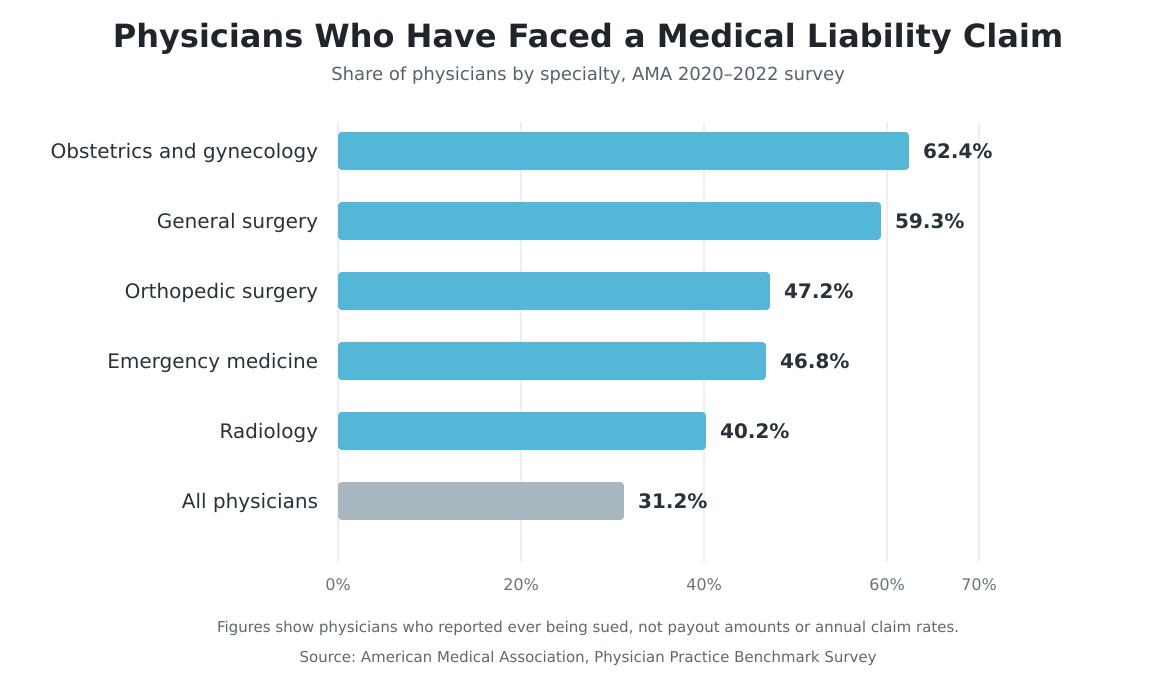
| Specialty Group | General Risk Level | Frequent Claim Issues |
|---|---|---|
| Obstetrics and gynecology | Very high | Birth injury, fetal distress and delayed delivery |
| General surgery | Very high | Operative injury and postoperative complications |
| Orthopedic surgery | High | Nerve injury, surgical technique and delayed diagnosis |
| Neurosurgery | High | Brain, spinal cord and nerve injury |
| Emergency medicine | High | Missed diagnosis and delayed treatment |
| Radiology | Moderately high | Missed or delayed diagnosis |
| Primary care | Moderate | Failure to diagnose and failure to refer |
| Psychiatry | Lower | Medication, monitoring and patient-safety claims |
How State Damage Caps Affect Payouts
Several states restrict non-economic damages in medical malpractice cases. The exact limit, exceptions and annual adjustment rules differ.
Economic Damages
Economic damages compensate measurable financial losses. They can include:
- past medical expenses
- future treatment and rehabilitation
- lost wages
- reduced future earning capacity
- home modification
- personal nursing and attendant care
Non-Economic Damages
Non-economic damages address losses that do not have a direct invoice or wage record. They can include:
- physical pain
- emotional distress
- permanent disfigurement
- loss of normal life
- loss of companionship
Punitive Damages
Punitive damages are designed to punish especially serious conduct. They are not available in every malpractice case.
State law can require proof of fraud, malice, recklessness or another level of conduct greater than ordinary negligence.
Selected State Medical Malpractice Limits
| State | General 2026 Framework | Main Effect |
|---|---|---|
| California | Separate indexed MICRA limits apply to non-economic damages | Economic damages remain separately recoverable |
| Texas | Non-economic limits apply by defendant category | Claims involving several institutions have additional rules |
| Virginia | A total damages limit applies to medical malpractice claims | The limit covers economic and non-economic recovery |
| Indiana | A total recovery limit works with the Patient’s Compensation Fund | Qualified providers have defined liability |
| Louisiana | A patient compensation framework applies to qualified providers | Future medical care can be handled separately |
| Maryland | An indexed non-economic damages limit applies | The amount depends on claim and beneficiary circumstances |
| Colorado | Statutory medical malpractice limits apply | Courts may consider defined exceptions |
| New York | No general statutory medical malpractice damages cap | Awards remain subject to judicial review |
| Arizona | The state constitution prohibits general damage limits | No broad statutory malpractice cap applies |
| Pennsylvania | No general compensatory damages cap | Punitive damages remain subject to separate rules |
State statutes and court decisions can change. The table provides a general comparison and does not state the amount available in an individual case.
Malpractice Insurance Costs Remain Under Pressure
Healthcare practitioners commonly purchase professional liability insurance to cover legal defense and qualifying settlements or judgments.
The American Medical Association has documented an extended period of medical liability premium increases. Premium changes differ by state, specialty, insurer and coverage limit.
High-Risk Specialists Pay More
Obstetricians, neurosurgeons and other high-risk specialists can pay substantially more than physicians in specialties with fewer severe claims.
Location matters as well. Insurers consider local claim frequency, jury awards, defense costs and the state legal framework.
A Larger Payout Does Not Equal a Larger Insurance Loss
Insurance policies have coverage limits. A payment above the applicable limit may involve excess coverage, hospital insurance, a compensation fund or the defendant’s own assets.
Defense costs can also be substantial in cases that produce no payment to the patient.
How Malpractice Costs Affect Healthcare Spending
Medical malpractice affects spending through insurance premiums, legal defense, settlements and administrative work.
Defensive medicine creates a separate concern. A clinician may order additional tests or consultations partly to reduce legal exposure.
Defensive Medicine Is Difficult to Measure
A test ordered after careful clinical judgment can serve both a medical and liability-management purpose. Researchers therefore produce different estimates of the national cost.
A frequently cited Health Affairs study of the medical liability system estimated that liability-related costs represented a limited share of total national healthcare spending. The dollar amount was still substantial.
Reducing Claims Does Not Automatically Reduce Patient Bills
Malpractice expenses are one part of healthcare costs. Hospital prices, prescription drugs, staffing, administration and insurance contracts have much larger effects on total national spending.
Tort reform can change liability expenses without producing a matching reduction in the price charged to every patient.
Insurance and Legal Implications
1. Policy Limits
A malpractice policy normally states a limit for each claim and a separate annual aggregate limit.
A policy written as $1 million per claim and $3 million annually can provide up to $1 million for one covered claim. The insurer’s total responsibility across all claims during the policy period is generally limited to $3 million.
2. Intentional Conduct May Be Excluded
Insurance is designed to cover professional negligence. Intentional harm, fraud and criminal conduct may fall outside the policy.
Coverage disputes can arise over late notice, excluded services, policy periods and the identity of the insured practitioner.
3. Hospitals Often Carry Separate Coverage
A hospital can face direct liability for staffing, credentialing, supervision or institutional policies. It may also face vicarious liability for an employee’s conduct.
Hospital coverage and practitioner coverage do not always respond to the same allegations.
The Role of Legal Representation

Medical malpractice cases require a detailed review of medical records, expert opinions and state filing rules.
An attorney may need to:
- identify the applicable standard of care
- obtain opinions from qualified medical experts
- determine which practitioner or institution may be responsible
- calculate future treatment and income losses
- review available insurance coverage
- file the claim within the applicable deadline
- comply with affidavits, certificates or presuit screening requirements
Deadlines Differ by State
Every state has a filing deadline. Some apply a separate statute of repose that can prevent a claim after a fixed period regardless of when the injury was discovered.
Rules can differ for children, wrongful death claims, foreign objects, fraud and government healthcare facilities.
What the NPDB Data Can and Cannot Show
| The Data Can Show | The Data Cannot Establish by Itself |
|---|---|
| Number of practitioner payment reports | Number of lawsuits filed |
| Estimated value of reported payments | Every dollar paid by hospitals |
| State connected to the practitioner | Exact location of every incident |
| Broad injury and allegation categories | Full medical history of the patient |
| Long-term reporting patterns | That every named practitioner was negligent |
Reports Are Confidential at the Individual Level
The public file removes information that could identify a practitioner, patient or reporting entity.
Hospitals, licensing boards and other authorized organizations can query information under federal rules. The public cannot use the statistical file to identify a particular clinician.
Frequently Asked Questions
Which state has the highest total medical malpractice payouts in 2026?
New York has the largest aggregate value of medical malpractice payments in the federal data.
Which states have the most malpractice payment reports?
New York, Florida, California, Pennsylvania and Texas are consistently among the states with the largest payment volumes.
Does every malpractice settlement appear in the NPDB?
No. Federal reporting focuses on payments made for the benefit of licensed practitioners. Some payments made only for hospitals or other entities are not included.
Does a payment prove that a physician committed malpractice?
No. A payment can result from a settlement reached without an admission of liability.
Do damage caps apply to medical expenses?
Many state caps target non-economic damages. Several states use different systems or broader total limits. State law must be checked separately.
What is the difference between negligence and a bad outcome?
Negligence requires a departure from the applicable standard of care. An unfavorable result can occur even when treatment meets that standard.
Which specialties have the greatest liability exposure?
Obstetrics, general surgery, orthopedic surgery and neurosurgery are among the specialties with high lifetime claim exposure.
Methodology
The article uses the National Practitioner Data Bank as the main statistical source. The NPDB Data Analysis Tool contains adverse-action and medical malpractice payment reports processed from September 1990 through March 31, 2026.
Medical malpractice figures refer to Medical Malpractice Payment Reports. They do not represent all lawsuits, court verdicts, hospital payments or allegations of medical error.
The NPDB assigns medical malpractice reports to the practitioner’s work state when that information is available. The home state or license state can be used when work-state information is unavailable.
Payment values in public NPDB analysis are estimates derived from reported payment ranges. Figures should not be treated as audited totals for every insurer or healthcare institution.
Partial 2026 figures were not presented as full-year totals. The federal database notes that reports arising near the end of a quarter can be filed during the next reporting period.
State legal comparisons were based on statutes, court rulings and professional legal summaries available in 2026. Damage limits can depend on the date of injury, number of defendants, type of loss and special statutory exceptions.
Final Thoughts
Medical malpractice payouts differ sharply between states, but total dollars alone do not measure the quality of a healthcare system.
Large states naturally generate more treatment encounters and more claims. States without broad damage caps can also produce larger payments in catastrophic cases.
Average payments require greater caution. One severe injury can place a small state at the top of the ranking even when it records very few reports.
The strongest comparison uses three measures together. Payment volume shows how many reports were filed. Total payments indicate the size of the state liability market. Average payment provides limited information about case value.
NPDB figures also have a defined scope. They focus on payments made for practitioners. They do not capture every lawsuit, institutional settlement or patient harmed by a medical error.
The state rankings are therefore best used as a measure of reported practitioner payments. They should not be treated as a complete count of medical negligence across the United States.
Sources
- National Practitioner Data Bank Data Analysis Tool
- NPDB Public Use Data File
- NPDB Guidebook on Medical Malpractice Payment Reports
- American Medical Association Medical Liability Resources