

A latest state ranking puts New Hampshire at the top of the 2026 moving list, followed by Utah, Idaho, Virginia, and Maine.
California, Louisiana, and New Mexico sit at the bottom of the ranking, according to the ConsumerAffairs analysis. The list compares states across the things people feel after the move is over, including affordability, safety, jobs, health care, education, and quality of life.
The ranking lands during another active period for interstate moves. ConsumerAffairs reported in its 2026 migration trends report that more than 7.1 million Americans moved from one state to another in 2024.
The Census Bureau also released its latest state-to-state migration tables, based on 2024 American Community Survey one-year data.
The report is useful because it separates a good place to visit from a good place to live. Warm weather, low taxes, or cheap homes can pull people in. Daily costs, crime, health care access, insurance, and wages decide how the move feels six months later.
New Hampshire Ranked First Because It Scores Well In More Than One Area
View this post on Instagram
The state ranked strongly for safety, health care, education, and quality of life. It also has no broad-based state income tax and no state sales tax, which helps some households compare take-home pay with daily costs.
However, the state is not cheap everywhere. Housing near Boston commuter areas and popular towns can be expensive. Winters add heating and travel costs. Smaller cities can also mean fewer job choices in some fields.
New Hampshire still stands out because it does not rely on one selling point. It offers a stronger mix of safety, public services, jobs, and daily life than most states in the report.
The Top Five States to Move In
The top five are New Hampshire, Utah, Idaho, Virginia, and Maine.
Utah is here because of job growth. Idaho appeals to people looking for safety and smaller-city growth. Virginia gives movers several job markets within one state. Maine fits people who value safety, air quality, and a slower pace.
| Rank | State | Main Strength | What To Check Before Moving |
| 1 | New Hampshire | Safety, health care, schools and quality of life | Home prices, winter costs, property taxes and local job options |
| 2 | Utah | Job growth and economic strength | Housing pressure, summer heat, water concerns and fast growth |
| 3 | Idaho | Safety and economic growth | Rising housing costs in Boise and other fast-growing areas |
| 4 | Virginia | Jobs, schools, health care and stability | Northern Virginia costs are much higher than many rural areas |
| 5 | Maine | Safety, air quality and outdoor life | Winter life, health care access and job depth outside larger towns |
Idaho held third place for the third year in a row. The state’s position reflects a mix of safety and job growth, although housing costs have risen in the places that have attracted the most newcomers.
Utah keeps drawing workers because of its economy, family structure, outdoor access, and business climate.
California, Louisiana, and New Mexico Landed At The Bottom
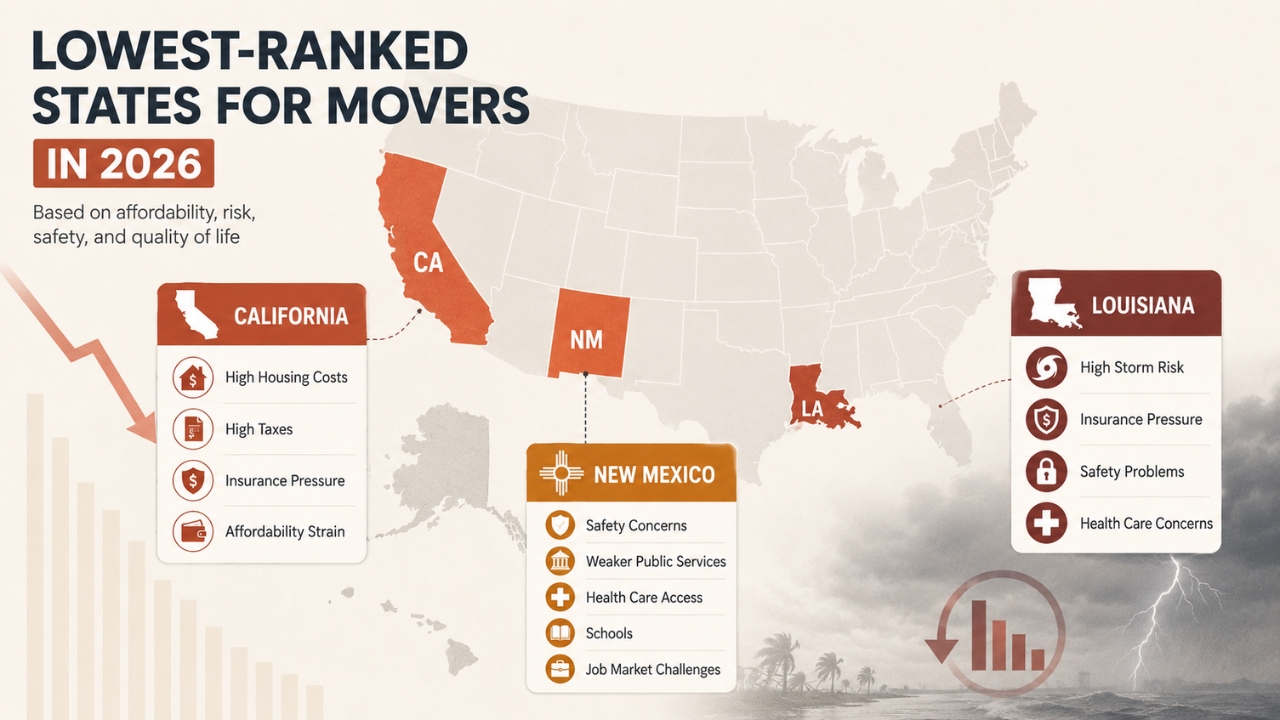
The bottom group tells a different story.
California falls because of the cost. Louisiana carries storm risk, insurance pressure, safety problems, and weaker health outcomes. New Mexico struggles with safety and several daily-life measures, even though parts of the state remain less expensive than the coasts.
| Bottom State | Main Problem For Movers | What To Review First |
| California | Housing costs, taxes, insurance pressure and affordability | Rent, home prices, commute costs, insurance and after-tax income |
| Louisiana | Storm risk, safety, health care, schools and insurance costs | Flood exposure, homeowners insurance, wages and hospital access |
| New Mexico | Safety and weaker scores across several public-service measures | Crime data, health care access, schools and local job market |
California is the clearest example of a state with strong opportunity and weak affordability at the same time. It still has major job markets, universities, hospitals and industries. Many middle-income households cannot make the math work.
The Public Policy Institute of California has also tracked the state’s migration pressure and the role of housing costs. ConsumerAffairs reported that 12,601 users wanted to leave California, compared with 5,436 considering a move into the state.
Louisiana and New Mexico show another problem. Lower home prices do not automatically create an easier life. Crime, health care access, schools, wages, insurance and disaster risk can take back the savings.
Florida Leads Move-In Interest, But That Does Not Make It The Best Move For Every Household
ConsumerAffairs found that Florida had the highest net move-in interest in 2026, with 4,269 more users interested in moving in than leaving.
Florida has clear pull. It has no state income tax, warm weather, a large retiree market, strong tourism jobs, growing metro areas and a lifestyle brand that attracts people from colder and higher-cost states.
The cost side is harder. Homeowners’ insurance is high. Flood insurance may be separate. Hurricane risk affects housing choices. Summer cooling costs can be heavy. Growth has pushed up prices in many areas.
Our report on homeowners insurance rates explains why insurance now belongs in every relocation budget, especially in Florida, Louisiana, Texas and other storm-exposed states.
Different Reports Measure Different Things
Migration rankings often conflict because they are not measuring the same behavior.
ConsumerAffairs measures user interest in moving to or away from a state. The Census Bureau measures actual residence changes through survey data. Moving companies measure their own customers. Truck rentals measure another kind of move.
| Source | What It Measures | Recent Finding |
| ConsumerAffairs | User interest in moving to or away from each state | Florida leads net move-in interest, and California leads net move-out interest |
| U.S. Census Bureau | State-to-state residence changes from ACS one-year data | New 2024 state migration flow tables were released in 2026 |
| USAFacts | Census-based migration summary | 7.16 million people moved between states in 2024 |
| United Van Lines | Moves handled by its moving network | Oregon led inbound moves in its 2025 study, and New Jersey led outbound moves |
| U-Haul | One-way truck and trailer transactions | Texas and Florida ranked high for one-way move gains in 2025 |
| PODS | Long-distance moves by its customer base | Its 2026 report tracks city and regional movement through customer moves |
The USAFacts migration summary says 7.16 million people, or 2.1% of the population age 1 or older, moved between states in 2024.
The United Van Lines 2025 National Movers Study said Oregon had the highest inbound share in its network, while New Jersey led outbound moves for the eighth straight year.
The U-Haul Growth Index uses one-way customer transactions, which capture a different moving group than full-service movers.
The PODS 2026 moving trends report adds another customer-based view of long-distance moves.
Cost Is The First Test Before Any Move

A state can look attractive until the full monthly budget is built.
Housing is the first number. The Redfin Data Center can help compare local home prices and sale trends by metro area. Renters should run the same check with local listings, not statewide averages.
Taxes come next. The Tax Foundation state income tax data helps compare income tax rates, but income tax alone does not settle the cost question. Property tax, sales tax, gas tax, insurance, and utilities can change the result.
Work also has to be local. The Bureau of Labor Statistics Local Area Unemployment Statistics can help compare job conditions below the state level.
- Compare rent or mortgage costs by city.
- Check homeowners’ or renters’ insurance before moving.
- Compare salary after taxes.
- Review car insurance and commute costs.
- Check health insurance networks before choosing a county.
- Compare childcare and school options.
- Add flood, fire, hurricane, heat, or winter costs where they apply.
A cheaper state can still leave a household worse off if wages fall, insurance rises or health care becomes harder to reach.
Safety Means Crime, Roads, and Disaster Risk
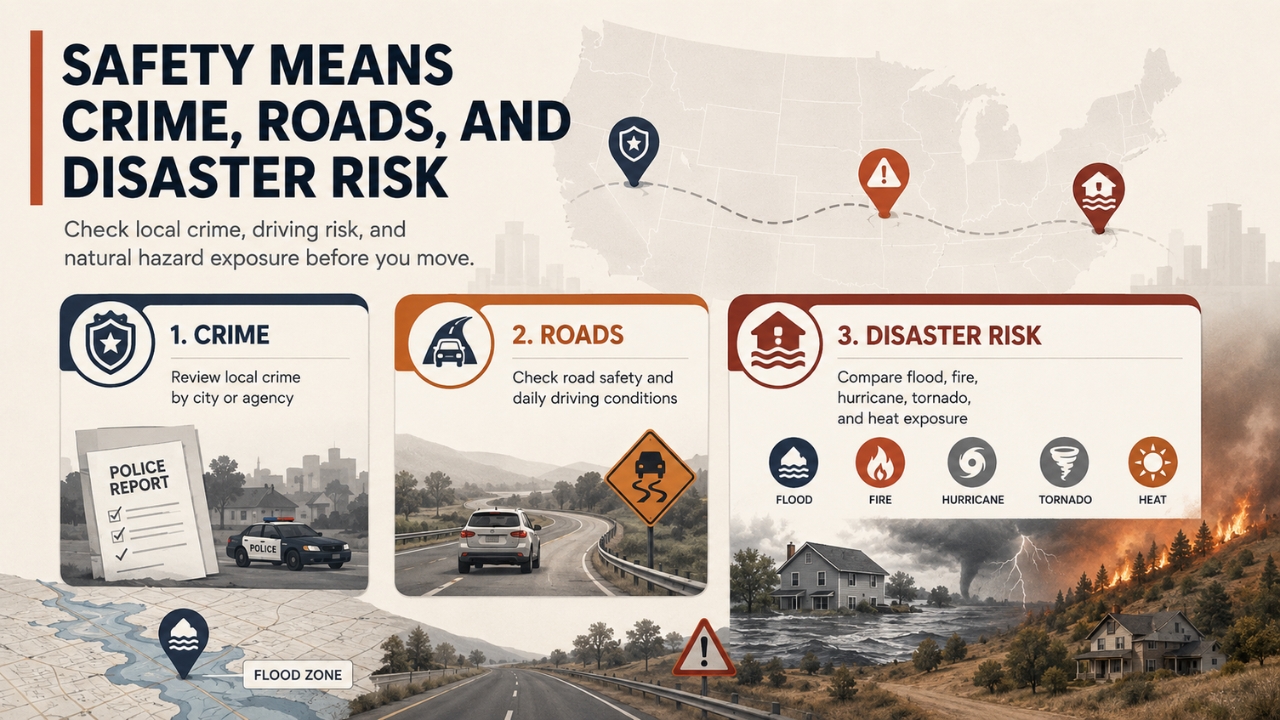
Safety is wider than crime.
The FBI Crime Data Explorer gives access to crime data that can be checked by state, city, or agency.
Flood exposure also belongs in the same decision. The FEMA Flood Map Service Center lets buyers and renters look up mapped flood zones.
Broader disaster exposure can be checked through FEMA’s National Risk Index, which compares counties by hazards such as hurricanes, wildfires, flooding, tornadoes, and extreme heat.
A home can be affordable and still carry a higher long-term cost because of storms, wildfire, heat, water limits, or insurance exclusions.
California Shows The Difference Between Opportunity And Affordability
California still attracts workers because it has jobs that many states do not offer at the same scale.
Tech, entertainment, health care, logistics, education, agriculture, and global trade all help keep the state powerful. Wages can also be high in several fields.
Housing is the MOST important aspect of California’s affordability crisis. I’ll build a million homes in four years. pic.twitter.com/6yqBXONagQ
— Tom Steyer (@TomSteyer) May 6, 2026
The same state is hard for people without high income or housing help. ConsumerAffairs cited California’s $820,800 median home sale price and 13.3% top marginal state income tax rate in its migration report.
That is why California can lose residents and still remain economically important. The state is not weak. It is expensive enough to push out people who would have stayed in an earlier housing market.
Florida And Texas Show How Popular States Can Get More Expensive
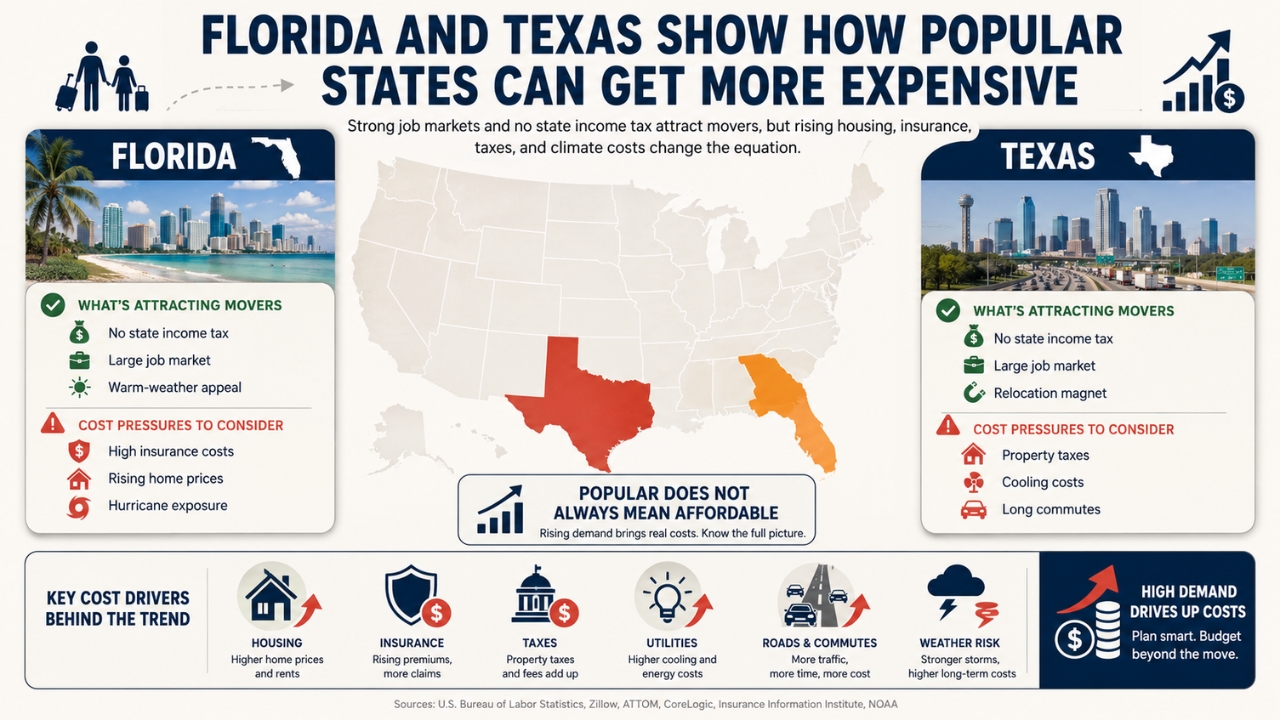
Florida and Texas remain strong relocation magnets.
Both offer no state income tax. Both have large job markets. Both have warm-weather appeal. Both show up often in moving-company and user-interest data.
Growth brings pressure. Roads get busier. Housing demand rises. Schools and health systems feel strain. Insurance costs can increase in storm-prone places. Water and heat become larger issues in some regions.
Florida may still work well for a retiree with a paid-off home and strong savings. It may be harder for a first-time buyer facing high insurance, rising prices, and hurricane exposure.
Texas may work well for a worker in a strong metro job market. It may be harder for a household that underestimates property taxes, summer cooling costs, or long commute patterns.
Best States Depend On The Type Of Mover
No state is best for everyone.
A remote worker, retiree, young family, college graduate and small-business owner need different things from a move.
| Type Of Mover | States To Study First | Reason |
| Remote worker looking for stability | New Hampshire, Maine, Virginia | Safety, quality of life and health care access can matter more than downtown job density |
| Worker chasing job growth | Utah, Idaho, Virginia | Stronger economic scores and growing employment markets |
| Family comparing schools and safety | New Hampshire, Virginia, Maine | Education, safety and health care scores are stronger |
| Retiree checking daily costs | Maine, New Hampshire, Virginia | Safety and health access may be worth more than warm weather alone |
| Cost-driven mover leaving a high-price state | Utah, Idaho, selected parts of Virginia | Better balance of jobs and cost than many coastal markets |
Readers comparing income should also use local wage and cost data. Our guide to middle-class income by state can help frame the income side of a move.
Questions To Answer Before Choosing A State
A state ranking should start the research, not end it.
| Question | What It Reveals |
| Can the household afford rent or mortgage after the move? | The move fails quickly if housing eats the budget. |
| Will wages rise, fall or stay flat? | A cheaper state can still hurt if income drops too much. |
| How much will insurance cost? | Home, renters, car, flood and health insurance can change the real price. |
| Can the household reach doctors and hospitals? | Health care access becomes urgent after the move, not before. |
| Are schools, childcare and commute patterns workable? | Daily logistics decide whether the move feels sustainable. |
| What natural hazards affect the area? | Storms, flood, wildfire, heat and winter costs can change long-term risk. |
| Is the move still affordable after one year? | First-month rent does not show the full cost of a new state. |
Methodology
This article uses the latest ConsumerAffairs state moving ranking as reported by CBS2 Boise, along with ConsumerAffairs’ 2026 migration trends report.
The migration section uses ConsumerAffairs data from 100,377 users who expressed interest in moving to another state between March 1, 2025, and March 26, 2026. That data measures interest, not completed moves.
Official migration context comes from the U.S. Census Bureau’s 2024 state-to-state migration flow tables and the USAFacts Census-based migration summary.
Additional moving context comes from United Van Lines, U-Haul and PODS. Cost, tax, job, crime and disaster checks are supported by Redfin, Tax Foundation, BLS, FBI and FEMA sources linked above.
Final Takeaway
@mapstate6 2026 top states for living #usmap #50states #2026 #top #living ♬ original sound – Mapstate
New Hampshire leads the latest 2026 moving ranking because it performs well across the parts of life that are hard to repair after a bad move: safety, health care, education, jobs and daily comfort.
California, Louisiana, and New Mexico fall to the bottom for different reasons. California is an affordability warning. Louisiana is a storm, insurance and public-service warning. New Mexico is a safety and access warning.
The best move is not the state with the loudest buzz or the warmest weather. It is the state where the household budget, job market, insurance, health care and daily routine still work after the moving truck leaves.